


Understanding Istanbul is about more than visiting individual historical landmarks. It means discovering how different civilizations and eras have shaped the same extraordinary city. From its role as the capital of the Roman and Byzantine Empires to its position as the administrative heart of the Ottoman Empire, from the cosmopolitan atmosphere of 19th-century Pera to the magnificent palaces lining the Bosphorus, Istanbul reveals more than two thousand years of history through its streets, architecture, and cultural heritage.
The best places to visit in Istanbul can therefore be explored as chapters in a fascinating historical narrative. With countless landmarks and hidden treasures waiting to be discovered, every corner of the city offers something unique. The key to a memorable Istanbul itinerary is not simply visiting as many attractions as possible, but exploring nearby landmarks together to experience each neighborhood at a more enjoyable pace.
Top 10 Places to Visit in Istanbul for First-Time Visitors
1. Hagia Sophia
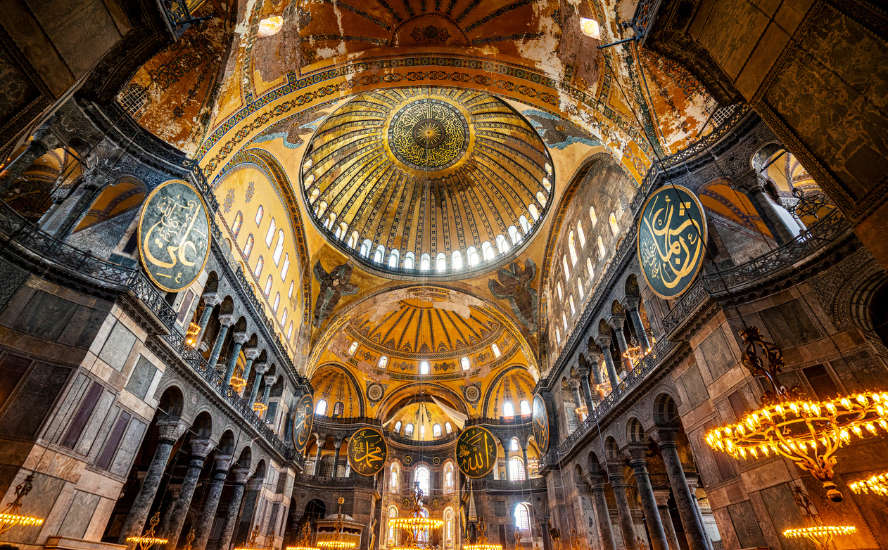
If Istanbul's remarkable history could be told through a single building, Hagia Sophia would undoubtedly be one of the strongest candidates. The first church on this site was built in 360 AD and was known as the "Megale Ekklesia," or Great Church. The present structure, regarded as the third Hagia Sophia, carries architectural and cultural traces of the city's successive historical periods. Its name means "Holy Wisdom," and the construction of the building that stands today dates back to the reign of Byzantine Emperor Justinian I, between 532 and 537 AD.
With its monumental dome, intricate marble craftsmanship, and magnificent mosaics, Hagia Sophia reflects the engineering brilliance and artistic grandeur of the Byzantine Empire. Following its conversion into a mosque during the Ottoman period, architectural elements such as minarets, a mihrab, and a minbar were added. Its exceptional cultural significance comes from this remarkable continuity across centuries.
Today, Hagia Sophia functions as an active mosque, so visitors should respect the relevant rules and customs. For those interested in exploring its fascinating past in greater detail, the Hagia Sophia History and Experience Museum is another worthwhile addition to the itinerary.
2. Blue Mosque (Sultan Ahmed Mosque)
Standing opposite Hagia Sophia, the Blue Mosque is one of the finest examples of 17th-century Ottoman architecture. With its six minarets, cascading semi-domes surrounding the central dome, and spacious courtyard, it is considered a true architectural masterpiece. The mosque is internationally known as the "Blue Mosque" because of the exquisite İznik tiles decorating its interior.
As the mosque remains an active place of worship, visitors should plan their visits around prayer times. Its location directly across from Hagia Sophia makes it easy to explore both landmarks consecutively. From there, you can continue to the historic Hippodrome and discover other ancient monuments, encountering traces of Roman, Byzantine, and Ottoman civilizations within just a few minutes' walk.
3. Topkapi Palace
Topkapi Palace served as the administrative center of the Ottoman Empire and one of the principal residences of the Ottoman dynasty for approximately four centuries. Unlike traditional European palaces, which often consist of a single monumental building, Topkapi Palace is an extensive complex of interconnected courtyards, pavilions, administrative chambers, and gardens. This distinctive layout reflects the hierarchy between public, governmental, and private spaces in Ottoman court life.
When exploring Topkapi Palace, paying attention to the transitions between its courtyards is just as important as admiring the individual buildings. These spaces offer valuable insights into the traditions and organization of palace life. Its commanding position overlooking the Bosphorus, the Golden Horn, and the Sea of Marmara also reveals the strategic relationship between the Ottoman seat of power and Istanbul's unique geography.
4. Basilica Cistern
The Basilica Cistern is one of the most fascinating surviving examples of Istanbul's underground Byzantine heritage. Constructed during the reign of Emperor Justinian I in the 6th century, it formed part of the water supply system serving the Great Palace and surrounding buildings. Its extraordinary interior, supported by hundreds of columns, creates an atmosphere unlike anywhere else in the city. Many of the column capitals were reused from earlier structures, reflecting the architectural practice of repurposing materials during the Roman and Byzantine periods.
Among the cistern's most recognizable features are two Medusa heads, one positioned sideways and the other upside down. These mysterious stone blocks have become some of the site's most popular attractions. Beyond their visual appeal, the cistern provides a fascinating insight into the sophisticated water infrastructure of ancient Constantinople. Located just a short walk from Hagia Sophia, it is an easy addition to any Sultanahmet sightseeing itinerary.
5. Grand Bazaar
Walking from Sultanahmet toward Beyazıt brings you to the Grand Bazaar, one of the most significant landmarks in Istanbul's commercial history. Its origins date back to the trading structures established during the reign of Sultan Mehmed II, also known as Mehmed the Conqueror. Over the centuries, the bazaar expanded into a vast network of covered streets, historic inns, and thousands of shops, maintaining its lively commercial character to this day.
Rather than heading directly to a particular shop, one of the best ways to experience the Grand Bazaar is simply to wander through its winding passageways. As you pass jewelry stores, carpet merchants, and antique dealers, take time to appreciate the architectural details. Vaulted corridors, historic fountains, traditional street names, and entrances to old caravanserais reveal the centuries-old trading heritage that continues to shape Istanbul's identity.
6. Galata Tower
Galata Tower is an essential landmark for understanding Istanbul's medieval history. Located across the Golden Horn from the Historic Peninsula, the tower's main structure dates back to the Genoese period in the 14th century. As one of the city's most recognizable landmarks, it stands within a neighborhood shaped by numerous communities over the centuries. From the Genoese and Ottomans to Levantine merchants and different religious communities, Galata's architectural landscape reflects a rich multicultural past.
The true charm of Galata extends beyond the tower itself. After enjoying panoramic views of Istanbul, explore the surrounding streets, including Galip Dede Street and Serdar-ı Ekrem Street, before continuing toward Tünel. Walking through these historic neighborhoods offers a deeper appreciation of the area's architectural character and urban transformation.
7. Istiklal Avenue and Taksim Square
Known as Cadde-i Kebir during the Ottoman period and Grande Rue de Péra in European sources, Istiklal Avenue was one of the main centers of cosmopolitan life in 19th-century Istanbul. The avenue was home to important embassies, theaters, churches, historic shopping arcades, and elegant apartment buildings. Its diverse architectural heritage continues to reflect the cultural richness of old Pera.
Taksim Square, meanwhile, holds an important place in the collective memory of modern Türkiye and the Republican era. Walking along Istiklal Avenue therefore offers an opportunity to trace Istanbul's transformation from the late Ottoman period to the modern Republic.
Rather than simply walking from one end of the avenue to the other, consider exploring nearby neighborhoods such as Asmalımescit, Çukurcuma, and Cihangir. Each offers a distinct atmosphere and reveals another dimension of Istanbul's cultural identity.
8. Dolmabahçe Palace
Dolmabahçe Palace reflects the changing political, architectural, and ceremonial traditions of the Ottoman Empire during the 19th century. Unlike the traditional courtyard-based layout of Topkapi Palace, Dolmabahçe was strongly influenced by European palace architecture. Its monumental structure, lavish interiors, and elegant waterfront façade make it one of the most impressive landmarks along the Bosphorus. The palace's direct relationship with the waterfront further enhances its architectural significance within the city.
Dolmabahçe Palace also holds a special place in the history of the Republic of Türkiye, as it was here that Mustafa Kemal Atatürk, the founder of the Republic, passed away. Located in Beşiktaş, the palace can easily be combined with a pleasant waterfront walk, followed by further exploration toward Beşiktaş or Kabataş.
9. Bosphorus Cruise
One of the most rewarding ways to understand Istanbul's extraordinary geography is to experience the city from the water. More than a scenic waterway, the Bosphorus is a natural strait that has shaped Istanbul's military, commercial, and political importance throughout history.
During a Bosphorus cruise, visitors can admire landmarks such as Dolmabahçe Palace, Beylerbeyi Palace, Rumeli Fortress, Anadolu Fortress, traditional Ottoman waterfront mansions, and the distinctive neighborhoods lining both shores.
Depending on your schedule, you can choose between shorter sightseeing cruises and longer Bosphorus tours to discover Istanbul's heritage from a different perspective. If time is limited, even a regular public ferry journey offers a wonderful opportunity to appreciate the city's beauty from the sea.
10. Balat and Fener
Balat and Fener are among Istanbul's most distinctive historic neighborhoods, preserving important traces of the city's multicultural social heritage. Fener has long been associated with the religious and cultural life of the Greek Orthodox community, while Balat retains elements of Istanbul's Jewish history. The Ecumenical Patriarchate of Constantinople, historic churches, former educational institutions, steep cobblestone streets, and colorful houses from different periods contribute to the area's unique character.
Rather than focusing exclusively on a few popular photography spots, take time to wander through the surrounding streets and experience the neighborhood's authentic atmosphere. You can then make your way down to the Golden Horn and continue along the waterfront, enjoying a quieter side of Istanbul.
Travel Tips for First-Time Visitors to Istanbul
To fully appreciate Istanbul's cultural heritage, it is helpful to organize your sightseeing itinerary around historical and geographical areas. The Historic Peninsula offers an introduction to the Roman, Byzantine, and early Ottoman periods. The Galata-Beyoğlu district reveals the city's commercial, diplomatic, and cosmopolitan life, particularly during the 19th century. Meanwhile, the Bosphorus waterfront showcases the palace architecture and residential traditions of the imperial era.
Instead of traveling between distant parts of the city on the same day, grouping attractions by neighborhood creates a more efficient and enjoyable itinerary.
Here are some useful tips for planning your first visit to Istanbul:
Plan visits to historical attractions in the same neighborhood on the same day.
Allow slightly more time than expected for museums and palace visits.
Use metro lines, trams, and ferries during peak traffic hours.
Wear comfortable walking shoes, as many sightseeing routes involve long walks and steep streets.
Include at least one ferry journey to experience both the European and Asian sides of the Bosphorus.
Set aside time to explore smaller streets and local neighborhoods beyond the main tourist attractions.
For a short three-day visit, focus on a few well-planned sightseeing routes rather than trying to see everything.
Choosing the right accommodation area also plays an important role in shaping your Istanbul experience. Staying in Beyoğlu provides convenient access to many of the city's most popular districts.
Located directly on Istiklal Avenue, Richmond Istanbul offers an excellent starting point for travelers wishing to explore Galata, Pera, Karaköy, and Taksim on foot. Thanks to its central location, guests can discover many of Istanbul's major attractions within walking distance while enjoying convenient public transportation connections to other parts of the city.


First-time visitors can begin their Istanbul journey in the Historic Peninsula, exploring Hagia Sophia, the Blue Mosque, Topkapi Palace, and the Basilica Cistern. The itinerary can then continue to Galata Tower, Istiklal Avenue, Dolmabahçe Palace, and the Bosphorus. Travelers with additional time may also dedicate a day to historic neighborhoods such as Balat and Fener.
Istiklal Avenue, Taksim Square, Sultanahmet Square, the streets of Balat and Fener, the Galata neighborhood, and many waterfront promenades along the Bosphorus can be explored free of charge. Active mosques may also be visited in accordance with their visiting rules, although specific visitor access arrangements and fees may apply. Museums, palaces, and certain historical attractions generally require an entrance ticket.
Spending at least three days in Istanbul is a good starting point for discovering its major historical and cultural attractions. A four- or five-day itinerary allows visitors to explore the Historic Peninsula, Beyoğlu, the Bosphorus, and other distinctive neighborhoods at a more relaxed pace.
Several of Istanbul's major attractions are located within walking distance of one another. Hagia Sophia, the Blue Mosque, the Basilica Cistern, and Topkapi Palace can all be explored within the same area. Similarly, Galata Tower, Istiklal Avenue, and Taksim Square form another convenient walking route. Visiting Dolmabahçe Palace, Balat, and different sections of the Bosphorus may require the use of public transportation.
Istanbul offers an extensive public transportation network that includes metro lines, trams, Marmaray commuter trains, buses, and ferries. The Istanbulkart transportation card can be used across most of these services. Trams are particularly convenient for exploring the Historic Peninsula, while Marmaray and ferries provide connections between the European and Asian sides of the city. Metro lines are also an efficient way to travel between central districts and avoid heavy road traffic.
