


When looking at Pamukkale from a distance, the eye is first drawn to the snow-white travertines that truly live up to their name. The bright layers spreading across the hillside render the rest of the region almost invisible. However, when you reach the upper section of the travertines, the scenery changes in an instant. Just a few steps away, aesthetic columns, arched gates, wide avenues, and a magnificent theater appear.
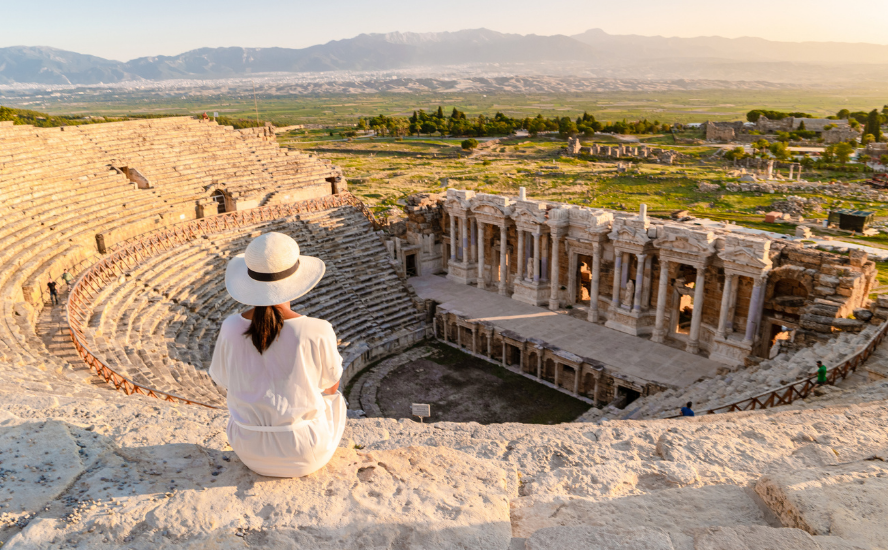
This is the Ancient City of Hierapolis, which grew around thermal waters and has survived to the present day bearing the traces of different eras over centuries. It is this unexpected encounter that transforms a trip to Pamukkale from a short stop completed with a few photos into a true journey through time. Located right behind the travertines, this ancient healing route is a vast historical adventure extending from Roman baths to the necropolis area, and from sacred structures to the ancient theater.
For this reason, before starting to explore Hierapolis, it is necessary to determine a rough route. Otherwise, while heading from the travertines to the ancient theater, it is quite easy to miss the ancient avenues, gates, the necropolis, or important religious centers. Likewise, starting the tour directly from the ancient city might not be the most suitable option for everyone. Temperature, walking distance, peak hours, and the spots you wish to see directly affect the Pamukkale Hierapolis travel plan. In this guide, we have gathered highlighted stops, route suggestions, and essential pre-trip details so you can explore the Ancient City of Hierapolis more consciously.
Where is the Ancient City of Hierapolis?
The Ancient City of Hierapolis is located within the borders of the Pamukkale district, approximately 18 kilometers north of Denizli city center. Since the ancient city and the Pamukkale travertines are located within the same archaeological site, it is possible to see both areas in a single visit plan. Transportation to the ancient city can be easily provided from Denizli center via public transport, taxi, or private vehicle.
The location of Hierapolis also explains the historical importance of the city. Developing around thermal waters in antiquity, the city became a frequent destination for both health seekers and travelers passing through the region. Today, visitors coming to the Ancient City of Hierapolis can see the travertines, the ancient pool, the necropolis area, the ancient theater, and various periodic traces of the city together on the same sightseeing route.
The archaeological site can be entered via the pedestrian (center), north, and south gates. Which gate is preferred directly determines the travel route. Those who want to walk up the travertines can evaluate the pedestrian entrance; those who want easy access to the ancient bath and travertines can choose the south gate; and those who want to grasp the history of the ancient city in chronological order and more deeply can opt for the north gate.
Since the ancient city tour trail spreads over a fairly wide area, the answer to "How long does it take to tour the Ancient City of Hierapolis?" depends entirely on route selection. The most comprehensive and ideal plan is to enter the city through the north gate, examine the ruins up to the ancient theater, then head to the museum section, and relax at the ancient bath and travertines toward sunset. For this, at least a few hours should be set aside for the ancient city tour.
A Brief History of Hierapolis
Hierapolis is accepted to have been founded in the early 2nd century BC by Eumenes II, King of Pergamon. The name of the city is thought to come from Hiera, the wife of Telephos, the legendary founder of Pergamon. Also referred to as the "Holy City" in archaeological literature due to the density of religious structures, the city was among the most famous healing centers of its era. With its natural spring waters and large bath complexes, it became a frequent stop for those seeking health.
Located on an earthquake belt, the city was rebuilt repeatedly after suffering major tremors throughout history and lived its golden age during the Roman Imperial Period. After being significantly reconstructed following the earthquake in 60 AD, its Hellenistic appearance was replaced by a grand and wealthy Roman city plan. A significant portion of the structures seen today bears traces of this period.
Hierapolis became an important center for Christianity during the Byzantine period. The belief that the Apostle Saint Philip was martyred here further strengthened the religious identity of the city, turning it into one of the most important Christian pilgrimage routes today. In subsequent centuries, the city shrank due to earthquakes and political shifts, and after the 14th century, it lost its significance and was completely abandoned. Thanks to bearing natural and cultural heritage together, the Pamukkale Travertines and the Ancient City of Hierapolis were inscribed on the UNESCO World Heritage List as a mixed site in 1988.
Places to Visit in the Ancient City of Hierapolis
When preparing a Hierapolis travel guide, listing the structures in the city one by one is easy. What really makes a difference on the travel route is seeing the relationship between these structures and noticing the period transitions. The ruins stretching from the main avenue to the baths, and from religious areas to the theater, offer strong clues about how daily life proceeded here and the sociological structure of the era.
1. Frontinus Gate and Street
The three-arched Frontinus Gate is among the most recognizable structures of Hierapolis. The wide street continuing past the gate forms the main transportation line of the ancient city. Flanking both sides of the street are shops, houses, storehouses, public buildings, as well as latrines (public toilets). The sewage system extending beneath the stone paving is one of the remarkable details proving the advanced urban planning of the era.
Pausing here briefly to look at both sides of the street and see the details in the aesthetic stonework makes it easier to understand the ruins as a whole. It is not at all difficult to imagine that these wide avenues, which seem silent today, were among the liveliest and wealthiest parts of the city centuries ago.
2. Ancient Theater of Hierapolis
Built on the hillside, the Ancient Theater of Hierapolis is one of the most impressive stops in the city. As you ascend the steps, both the details of the stage building and the plain below become clearer. The columns, reliefs, and architectural pieces on the decorated stage facade of the theater are important and rare examples bringing the grandeur of the Roman period to the present day.
Because the road leading up to the theater is inclined, you should not rush on this route, especially on hot days. Bringing water, a hat, and an umbrella, or not leaving this part of the visit to the midday heat makes the tour much more comfortable.
3. Temple of Apollo and Plutonium
The Temple of Apollo is located in the religious center of the city. According to rumor, the history of the Ancient City of Hierapolis relies on a small cult in this same religious center. The nearby Plutonium, on the other hand, was considered a gateway to the underworld in ancient times due to toxic gases emerging from underground and inspired mythology. This area is important for understanding why Hierapolis was called the "Holy City."
The relationship between temple ruins, thermal springs, and the natural structure of the region is clearly felt here. The way ancient societies explained natural phenomena through religious meanings and connected them to divine myths directly shaped the urban identity of Hierapolis.
4. Necropolis of Hierapolis
The necropolis to the north of the city is one of the largest ancient burial grounds in Southwestern Anatolia. Sarcophagi, tumuli, and monumental tombs from different eras are lined up along a long path.
The necropolis is one of the most frequently skipped sections in terms of time among the places to visit in Hierapolis. Yet, the diversity in tomb types provides important information about the social structure and beliefs of the communities living in the city. The vastness of the necropolis area stems from the city's function as a healing center. Travelers who sought healing and health in this city throughout the ages were buried here, carrying their own cultural heritage to this geography. If you want to see this area, starting your travel route from the north gate might be a better choice for you.
5. Martyrium of Saint Philip
Built in honor of Saint Philip, the octagonal Martyrium is one of the prominent structures of the city in terms of the Christian period. Located slightly outside the center and at a high point, reaching here requires a somewhat longer walk compared to other stops.
The view encountered at the end of the road is well worth the effort. Aside from its religious significance, the location of the structure offers a dominating view of the surroundings. If your time is limited, you can skip this section, but if you want to explore Hierapolis in detail and gain in-depth knowledge about its history, you should definitely add it to your main route.
6. Hierapolis Archaeology Museum
The Roman Bath structure of the ancient city is used today as the Hierapolis Archaeology Museum. Statues, sarcophagi, and various archaeological artifacts unearthed from Hierapolis, as well as Laodicea and other surrounding ancient settlements, are exhibited in the museum.
Entering the museum after touring the outdoor structures places the ruins seen outside into historical context. It is necessary to allow sufficient time, especially for the statue and sarcophagus halls.
7. Ancient Pool and Pamukkale Travertines
The connection Hierapolis established with thermal waters continues today. The Ancient Pool, with its thermal water accumulated among columns and marble pieces, is one of the most curious spots in the region. Since the availability of the pool can change periodically due to maintenance and conservation work, checking official announcements prior to your visit is recommended.
The Pamukkale travertines were formed by waters rich in calcite flowing along the hillside. The terraced pools, petrified waterfalls, and white mineral surfaces highlighted in UNESCO's description present a unique natural heritage area with an extraordinary appearance.
In the sections of the travertines open to visitors, shoes must be removed. Since the ground can be slippery and uneven in places, walking slowly and being careful will make things easier for you.
How Many Hours Does It Take to Visit the Ancient City of Hierapolis?
To see the travertines and the fundamental structures of the ancient city, at least three hours should be allocated to the city tour. A more relaxed route consisting of the theater, museum, main street, and travertines can be completed in about four hours. When the Necropolis and the Martyrium of Saint Philip are added to the itinerary, the visit can spread over half a day.
In summer months, early morning hours and the final part of the day offer a more comfortable walk. At noon, the light reflected from the white travertines and the shadeless areas in the ancient city can be overly exhausting. Spring and autumn, on the other hand, feature more acceptable weather conditions for long walks. Night museum tours offered in Hierapolis during the summer months also allow you to establish a more meaningful and deeper connection with the region, while serving as an ideal option to avoid being affected by heatwaves.
Due to areas such as stone-paved roads, sloping paths, and travertine ground, you should prefer comfortable and non-slip shoes before touring the Ancient City of Hierapolis. Especially in warm months, you should have a hat, sunscreen, and water in your bag. Entry hours to the Ancient City of Hierapolis, night museum fees, and closing hours of sections like the bath may vary according to seasonal practices. For Museum Pass validity, current visiting hours, the status of the Ancient Pool, and ticket information, you can visit official pages prior to your journey.
Complete Your Pamukkale Trip with Richmond Pamukkale Thermal
Exploring Pamukkale and its surroundings often means long walks and hours spent outdoors throughout the day. Completing the day at a calmer pace after this journey extending from the Ancient City of Hierapolis to the travertines makes the travel experience much more enjoyable and memorable. The region's thermal culture, continuing for centuries, also transforms the moment of rest into a natural part of a Pamukkale trip.
Located in Karahayıt, Richmond Pamukkale Thermal allows you to end your regional tour in a restful manner with comfortable accommodation areas, indoor and outdoor thermal pools, a sauna, a Turkish bath, and spa facilities. Following a long day spent on the stone paths of Hierapolis, you can turn your route to Richmond Pamukkale Thermal, transforming this cultural itinerary into a healing ritual.
